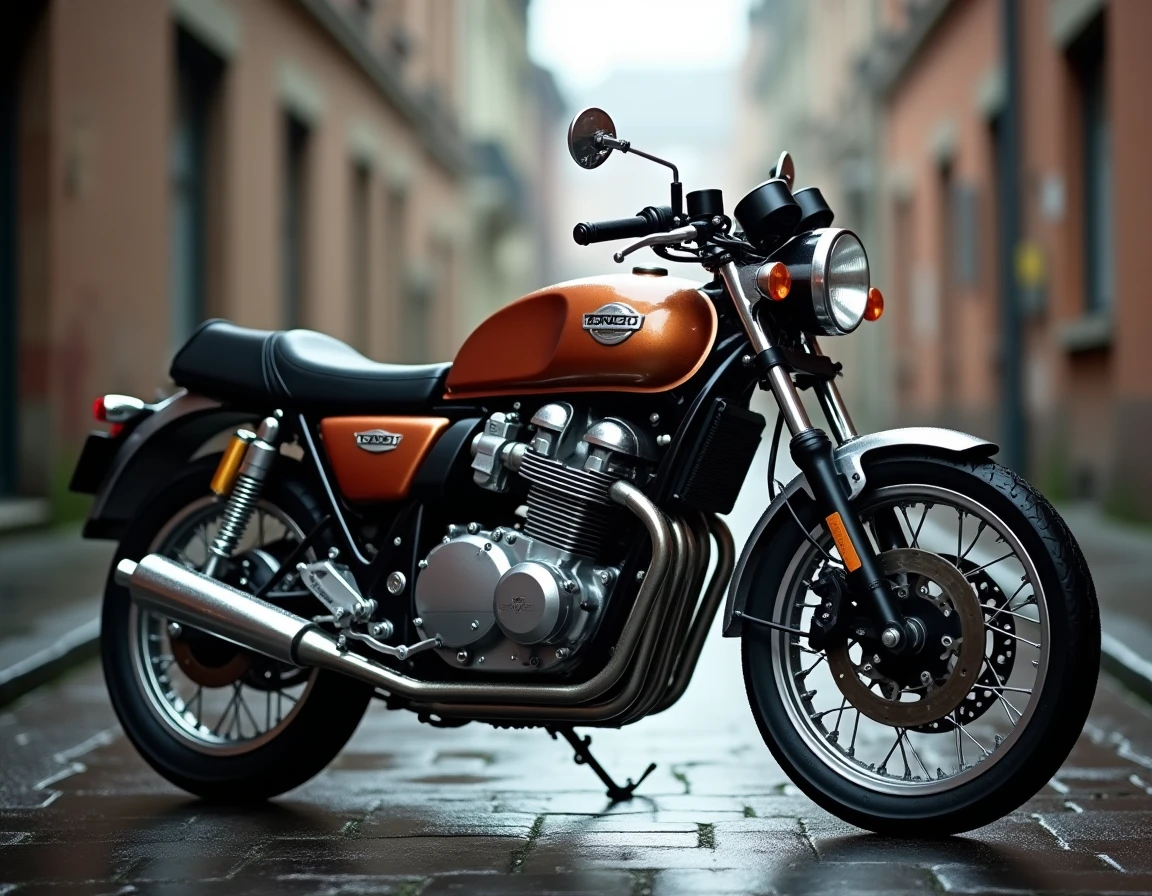
The restricted Honda CB750 Hornet at 35 kW checks all the boxes on paper: 270° inline twin-cylinder, diamond frame steel chassis, onboard electronics (traction control, riding modes, anti-wheeling). However, we observe in the workshop and on slow tracks behaviors that deserve a less enthusiastic analysis than that of classic tests.
Low-End Torque and Engine Brake Management on the Restricted CB750 Hornet

The software restriction of the CB750 Hornet brings the power down to the regulatory 35 kW, but it does not linearize the torque curve in the same way across the rev range. Below 3,000 rpm, the residual torque remains significantly higher than that of a CB500F in the same range. The 755 cm³ engine retains a higher crankshaft inertia, which generates a more pronounced engine braking during deceleration.
For a holder of an A2 license coming off a training bike of 300 or 500 cm³, this engine braking can be surprising when entering a roundabout or during a sudden downshift. The difference in rotating mass between a 500 twin and a 750 does not appear in any manufacturer’s specifications, but it is felt from the first kilometers in the city.
Before choosing a Honda CB750S for A2, we recommend riding for at least half a day on open roads, not just in a dealership parking lot. The behavior when releasing the throttle in a tight corner at 25 km/h reveals much more than a lap around the block.
Young A2 License Insurance: The Hidden Cost of the CB750 Hornet
Comparators and brokers classify the restricted CB750 Hornet in a significantly higher price category than the CB500F or CB500X, even at the same A2 power level. The reason lies in the claims-to-power ratio and the statistical profile of buyers: younger, more urban, with more reported material claims.
In practice, the annual premium for a 20-year-old rider on a restricted Hornet 750 is close to that of some unrestricted 900 cm³ bikes. The gap with a CB500F can represent several hundred euros per year, a cost that many beginners discover only after signing the order form.
Items to Compare Before Signing
- The comprehensive insurance premium for young drivers, by requesting quotes for both the Hornet 750 AND the CB500F to measure the actual difference
- The cost of side fairing parts in case of a stationary drop, which is common in the first year (the plastic of the Hornet is replaced at a higher cost than that of the 500)
- The excess for glass breakage and accessories, often higher on bikes equipped with a color TFT and electronic sensors
The actual budget for a CB750 Hornet in A2 far exceeds just the catalog price. We find that the argument “a bike I will keep after derestriction” does not always compensate for two or three years of additional premiums.
Electronic Aids on A2 Motorcycles: What Traction Control Does Not Correct
The Hornet 750 features traction control (HSTC), anti-wheeling, and three riding modes. On a roadster of this displacement, these systems are reassuring. They also create a false sense of security for a rider coming off the training course.
Several driving instructors remind us that traction control does not intervene on poorly modulated front brake pressure in a curve. Anti-wheeling does not compensate for a gaze fixed on the pavement two meters in front of the wheel. And no “Rain” mode shortens the emergency braking distance when the entry speed into a turn is too high.
The A2 training still predominantly takes place on bikes of 300 to 500 cm³ without these aids. Therefore, the new license holder has no experience with their operation or limitations. An ABS that regulates does not mean that braking is optimal, it means that the wheel does not lock up. The nuance is technical, but it changes everything in a real avoidance situation.
CB750 Hornet vs. CB500F in A2: Which Honda Roadster to Progress
We do not recommend the CB500F by default, but the comparison sheds light on the compromises. The 500 weighs about twenty kilograms less, offers a slightly lower center of gravity, and provides a more predictable engine response at mid-rev. For an average build (under 1.75 m), the difference in maneuverability at slow speeds is tangible.
The Hornet 750 has the advantage in pure enjoyment: its 270° twin delivers a rounder sound, a sharper response above 5,000 rpm, and superior highway comfort thanks to a lower cruising speed. It is a bike that one keeps after derestriction, a valid argument if one is sure not to sell within the first two years.
Objective Decision Criteria
- Planned annual mileage: above 8,000 km/year with highway use, the 750 justifies itself with its cruising comfort
- Rider’s build: below 1.70 m, the seat height and weight of the Hornet complicate stops on slopes
- Overall budget over three years (insurance, maintenance, depreciation): the CB500F costs significantly less to own over this period
- Plans for derestriction: if you plan to go full power within two years of getting your license, the 750 avoids a bike change
The CB750 Hornet is neither a trap nor a miracle bike for the A2 license. It is a coherent choice for a specific profile: a rider over 1.75 m, regularly riding outside urban areas, willing to absorb an insurance cost increase and aware that onboard electronics do not replace the skills acquired through practice. For all other profiles, Honda’s 500 range remains a more rational entry point.